WELCOME TO OUR BLOG

We're sharing knowledge in the areas which fascinate us the most
click

Truck Mounted Crane: Key Benefits & Practical Uses You Need to Know

By globalmachex March 30th, 2026 14 views

Quick Intro—Why a Crane That Drives Itself Changes Everything


Traditional cranes are great at one thing: lifting. But they don’t drive themselves to the job. They don’t load themselves. They don’t haul material across the site. They sit there, they lift, and that’s it.

A truck-mounted crane does all of it. It’s a truck that hauls, plus a crane that lifts, all in one package. You load it at the yard, drive it to the site, unload it where you need it, and keep moving. No forklift waiting at the other end. No second vehicle. No extra operator.

The time you save alone is worth the investment. But the real advantage is the flexibility. Need to put a steel beam on the third floor? Drive up, set the outriggers, lift. Need to unload a trailer full of pavers? Same truck, same operator, done in minutes. That’s the kind of versatility that makes job site logistics a whole lot simpler.

Answering the Main Question


What Exactly Is a Truck-Mounted Crane?

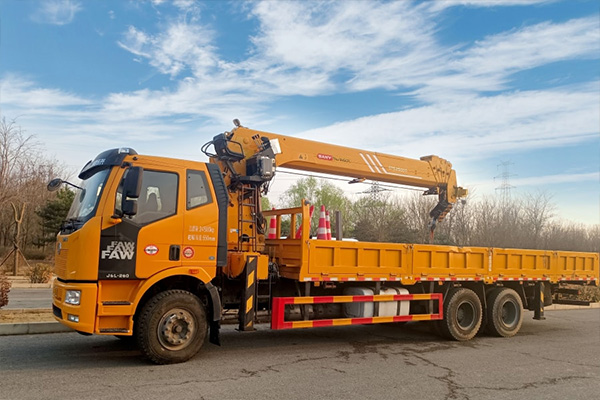
It’s exactly what it sounds like. A truck with a hydraulic crane mounted on the deck. Usually behind the cab, sometimes at the rear. The crane swings, lifts, and places material while the truck handles the hauling .

Most have 4 to 8 wheels and can carry 30 tons or more of material. Lifting capacities vary, but typical models reach up to about 60 feet vertically and 30 feet horizontally .

The crane can be operated from inside the cab or outside, so the driver doesn’t have to climb in and out to make every lift. Remote controls are common on newer models, which means you can stand where you need to see the load, not where the controls happen to be.

Why People Switch and Never Go Back

One Machine, Multiple Jobs

Instead of a crane plus a flatbed plus a forklift, you’ve got one truck. Load it, move it, unload it. That’s fewer machines to buy, fewer to maintain, fewer operators to pay .

Show Up and Work

No waiting for the crane to arrive after the material. No staging everything in a pile, then moving it again. You drive onto the site, position the truck, and start lifting. The setup time is measured in minutes, not hours .

Fits Where Other Cranes Can’t

Stationary cranes need flat ground, outrigger space, and a clear path to the lift. Truck-mounted cranes are more forgiving. If you can drive the truck there, you can probably lift there. That means tighter sites, rougher terrain, and fewer headaches .

Saves Money

Fewer machines to buy. Fewer machines to maintain. One operator instead of two or three. And because you’re not waiting for equipment, your crew stays productive .

Load and Unload Without Help

Here’s the big one. You don’t need a forklift at both ends. Load at the supplier’s yard with your own crane. Unload at the site with the same crane. That means you’re not waiting on someone else’s equipment or schedule .

How to Actually Use One to Get Your Money’s Worth


Step One: Figure Out What You’ll Be Lifting

Before you buy or rent, think about your typical loads. Pallets of bricks? Steel beams? Agricultural equipment? Shipping containers? The crane’s lift capacity and reach need to match your work .

If you’re mostly moving palletized materials, a brick grab or fork attachment makes life easier. If you’re handling odd-shaped loads like machinery, you’ll want chains, hooks, or timber grabs.

Step Two: Pick the Right Configuration

Truck-mounted cranes come with different rotation options—180 degrees or full 360 . If you need to work around the truck, go with 360. If you’re mostly loading and unloading straight off the back, 180 might be plenty.

The location of the crane matters too. Behind the cab leaves more deck space. At the rear makes it easier to work off the back without climbing over loads.

Step Three: Train Your Operators

Just because it’s on a truck doesn’t mean it’s simple. Operators need to understand load charts, outrigger placement, and how to work safely in tight spaces. Remote controls are handy, but they don’t replace knowing what you’re doing .

Step Four: Match Attachments to the Job

The crane is only as useful as the attachment on the end. Brick grabs for masonry. Forks for pallets. Hooks for chains and straps. Grapples for loose materials like timber or scrap. Having the right attachment turns a crane into a precision tool instead of a brute-force machine .

Step Five: Plan Your Moves

Just because you can drive anywhere doesn’t mean you should. Know where you’re going before you get there. Overhead wires, soft ground, low branches—all of it matters. A truck-mounted crane is still a crane. Treat it like one.

Summary


Here’s the short version for when you’re standing in the yard wondering if a truck-mounted crane is worth it:

  • One machine does the work of a truck, a crane, and sometimes a forklift.
  • Show up, set up fast, lift. No waiting for equipment to arrive.
  • Fits in tighter spaces than stationary cranes. Less site prep.
  • Fewer machines to buy and maintain. One operator instead of two or three.
  • Load at the supplier with your own crane. Unload at the site. No waiting on forklifts.
  • Pick the right rotation, the right attachments, and train your people.

The contractors who use truck-mounted cranes don’t think of them as a luxury. They’re a tool that pays for itself in time saved and logistics simplified. Once you’ve had one, you’ll wonder how you managed without it.

Frequently Asked Questions

Q: What’s the difference between a truck-mounted crane and a mobile crane?

A: A mobile crane is a dedicated lifting machine that drives itself. A truck-mounted crane is a cargo truck with a crane attached. The truck hauls material and lifts it .

Q: Do I need a special license to drive one?

A: In most places, yes. If the truck is over 26,000 pounds, you need a commercial driver’s license. Some states also have endorsements for crane operation. Check local rules .

Q: How much weight can a truck-mounted crane lift?

A: Depends on the model. Small ones lift a few tons. Larger models can handle 30 tons or more. Reach matters too—the farther out you go, the less you can lift .

Q: Can I use it for more than construction?

A: Yes. Agriculture, freight, landscaping, utility work—anywhere you need to move heavy, awkward loads. Farms use them for moving equipment. Warehouses use them for loading and unloading .

Q: How long does it take to set up?

A: Minutes. Park, set the outriggers, level the truck, start lifting. Nothing like the hours it can take to set up a stationary crane .

Q: What attachments should I have?

A: Depends on your work. Brick grabs for masonry, forks for pallets, hooks for chains and straps, grapples for loose materials like timber. Match the attachment to the job .

Why Particle Size Matters in Mining: From Blast to Buyer
Previous
Why Particle Size Matters in Mining: From Blast to Buyer
Read More
Torque Specifications: The Difference Between a Bolt That Holds and a Bolt That Snaps
Next
Torque Specifications: The Difference Between a Bolt That Holds and a Bolt That Snaps
Read More