WELCOME TO OUR BLOG

We're sharing knowledge in the areas which fascinate us the most
click

Torque Specifications: The Difference Between a Bolt That Holds and a Bolt That Snaps

By globalmachex March 31st, 2026 11 views

Quick Intro—Why You Can't Just "Make It Tight"


Most of us learned to tighten bolts by feel. Turn it until it feels right. Maybe give it a little extra for good measure. And for holding a shelf on the wall, that's probably fine.

But for anything that matters—bridges, pressure vessels, engine components, heavy equipment—"by feel" is a fast track to failure.

A bolt isn't just holding two pieces together. It's providing clamping force. That force keeps the joint from moving, from vibrating apart, from leaking, from failing. And the only way to control that force is to control the torque.

Too little, and the joint works loose. Things shift, wear out, and eventually come apart. Too much, and the bolt stretches. Stretched bolts don't spring back. They're weaker. They crack. They snap.

The spec exists for a reason. Someone calculated exactly what that bolt needs to do, and that number is the answer.

Answering the Main Question


What Torque Actually Is

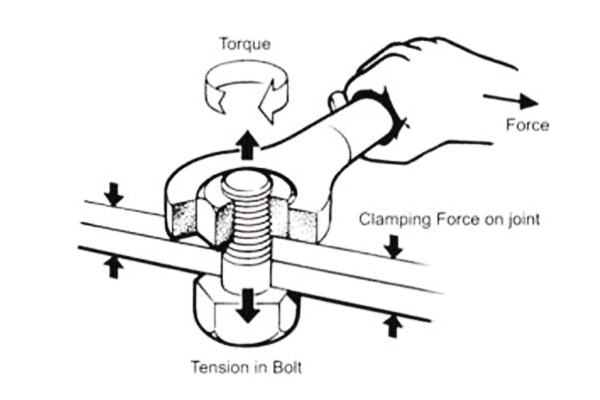
Torque is rotational force. Think of it as twisting power. You put a wrench on a bolt and pull, and the amount of twist you apply is torque .

When you tighten a bolt, you're doing two things. First, you're stretching the bolt like a rubber band. That stretch creates clamping force that holds the joint together . Second, you're overcoming friction between the bolt, the nut, and the joint surfaces .

The torque spec isn't just about the bolt. It's about how much stretch you need to create the right clamping force without exceeding what the bolt can handle.

Why Specifications Exist

Torque specs aren't someone's best guess. They're calculated based on:

  • The bolt material. Steel bolts have different limits than stainless or alloy .
  • The bolt size. Bigger bolts can handle more torque .
  • The joint materials. Soft materials can't take the same clamping force as hard ones .
  • The expected load. How much force will the joint need to hold? .
  • The environment. Will it be hot? Cold? Corrosive? All of that matters .

Engineers figure out exactly how much stretch the bolt needs to do its job. Then they calculate the torque required to get that stretch, accounting for friction and everything else.

That number is the spec. It's not optional.

What Happens When You Over-Tighten

Bolt Stretch and Failure

Bolts are designed to act like springs. They stretch a little under load and spring back when the load is removed. But every bolt has an elastic limit—the point where it stops behaving like a spring and starts behaving like a piece of stretched-out metal .

Go past that limit, and the bolt doesn't spring back. It's permanently stretched. Weaker. One step closer to snapping.

Joint Damage

Over-tightening doesn't just hurt the bolt. It can deform the joint itself. Gaskets crush. Flanges bend. Threads strip. Components crack .

Once the joint is damaged, the bolt can't do its job even if it's torqued perfectly.

Hydrogen Embrittlement

This one's nasty. In certain environments—especially with hardened bolts—over-tightening can make hydrogen atoms work their way into the metal. The bolt becomes brittle. A little stress later, and it snaps without warning .

What Happens When You Under-Tighten

Loose Joints

Under-tightened bolts don't provide enough clamping force. The joint moves. Vibration works it loose over time. Things that should be tight start rattling .

Premature Wear

When a joint moves, components wear against each other. Gaskets fail. Surfaces frett. Once the wear starts, it doesn't stop until something breaks .

Uneven Load Distribution

In a joint with multiple bolts, under-tightening means some bolts do more work than others. A few bolts carry the whole load while the rest just ride along. Those overloaded bolts fail. Then the next ones. Until the joint comes apart .

How to Actually Get It Right


Step One: Know the Spec

Before you pick up a wrench, know what you're aiming for. Check the manual. Look for the spec. Don't guess.

Step Two: Use the Right Tools

A torque wrench isn't optional. It's how you measure what you're applying. Use it. Calibrate it. Take care of it .

Step Three: Account for Lubrication

Most torque specs assume clean, dry threads. If you use lubricant, the friction changes, and the torque required to get the same stretch is different . Some specs specify "wet" or "dry." Know which one you're dealing with.

Step Four: Tighten in Steps

For critical joints, don't just crank it to spec in one shot. Multiple passes—like a third, then two-thirds, then full torque—let the joint settle and give you a more accurate result .

Step Five: Consider the Sequence

If a joint has multiple bolts, the order matters. Tighten in the right pattern to distribute the load evenly. Usually it's a cross pattern or a spiral from the center out .

Step Six: Mark It

Paint marks across the bolt and the joint tell you at a glance if something has moved. A quick visual check can catch a loose bolt before it becomes a problem .

Step Seven: Train Your People

Anyone who picks up a torque wrench needs to know why it matters. A five-minute lesson on what torque does and what happens when it's wrong is worth more than any tool in the box.

Summary


Here's the short version for when you're standing there with a wrench wondering how tight is tight enough:

  • Torque is rotational force. It stretches the bolt to create clamping force.
  • Specs exist because engineers calculated exactly what the bolt needs to do.
  • Over-tightening stretches the bolt past its limit. It weakens, cracks, and snaps.
  • Under-tightening leaves joints loose. Things move, wear out, and fail.
  • Lubrication changes the friction. Account for it.
  • Tighten in steps and in the right sequence for critical joints.
  • Use a torque wrench. Guesswork has no place in critical fastening.

A bolt that's torqued right holds for years. A bolt that's torqued wrong holds until it doesn't. The spec is there for a reason. Follow it.

Frequently Asked Questions

Q: Can I use a regular wrench instead of a torque wrench?

A: If the joint matters, no. A torque wrench is how you know what you're applying. Guessing is how things fail .

Q: What's the difference between dry and lubricated torque specs?

A: Lubricant reduces friction, so the same torque produces more bolt stretch. Dry threads have more friction, so you need more torque to get the same stretch .

Q: How often should I calibrate my torque wrench?

A: Once a year, or more often if it's used daily. A torque wrench that's out of calibration is worse than no torque wrench .

Q: Can I reuse a bolt that was over-tightened?

A: Probably not. Once a bolt has stretched beyond its elastic limit, it's weaker. Replace it .

Q: What's hydrogen embrittlement?

A: A phenomenon where hydrogen atoms get into the metal, making it brittle. Over-tightening can cause it in certain bolts, especially in corrosive environments .

Q: Why does the sequence matter when tightening multiple bolts?

A: Tightening in the wrong order can distort the joint and leave some bolts loose. The right sequence distributes the load evenly .

Truck Mounted Crane: Key Benefits & Practical Uses You Need to Know
Previous
Truck Mounted Crane: Key Benefits & Practical Uses You Need to Know
Read More
Tractor Beginners: 5 Mistakes That'll Make You Regret It
Next
Tractor Beginners: 5 Mistakes That'll Make You Regret It
Read More