Categories

Stationary Excavator Guide: Technical Specs, ROI & Heavy-Duty Applications

This technical guide examines the stationary excavator's powertrain, hydraulic efficiency, and structural durability, delivering data-driven ROI analysis for mining, construction, and industrial earthmoving operations.
May 28th,2026 6 Views

Introduction: The Productivity Bottleneck in Fixed-Material Handling

Construction aggregates, port handling, and mine loading operations face a persistent challenge: how to achieve continuous excavation performance without mobility overhead. Traditional wheeled or tracked excavators carry undercarriage complexity, higher fuel burn per ton, and more frequent maintenance due to travel stress. The stationary excavator eliminates these variables. Engineered for fixed-position, high-cycle material processing, these machines deliver 15-20% lower total cost of ownership (TCO) compared to mobile equivalents in dedicated loading or hopper-feeding roles. Modern stationary excavators integrate ISO 6165 structural standards, EPA Tier 4 Final or EU Stage V emissions compliance, and ROPS/FOPS-certified cabins. This blog provides a powertrain-deep technical specification, comparative ROI modeling, and heavy-duty application scenarios for engineering and procurement professionals.

Core Powertrain & Structural Design

Engine & Fuel System

Stationary excavators use electronically controlled diesel engines optimized for constant RPM operation. A typical 45-ton class machine produces 270-320 hp (201-239 kW) at 1,800-2,000 rpm. Common rail direct injection with ECU-managed fuel mapping reduces consumption to 15-22 L/h under full load. EPA Tier 4 systems employ DOC+DPF+SCR aftertreatment, while EU Stage V adds a diesel particulate filter. Engine life exceeds 15,000 hours when operated with ≤0.0015% sulfur fuel and synthetic 10W-30 oil changes every 500 hours.

Hydraulic System Architecture

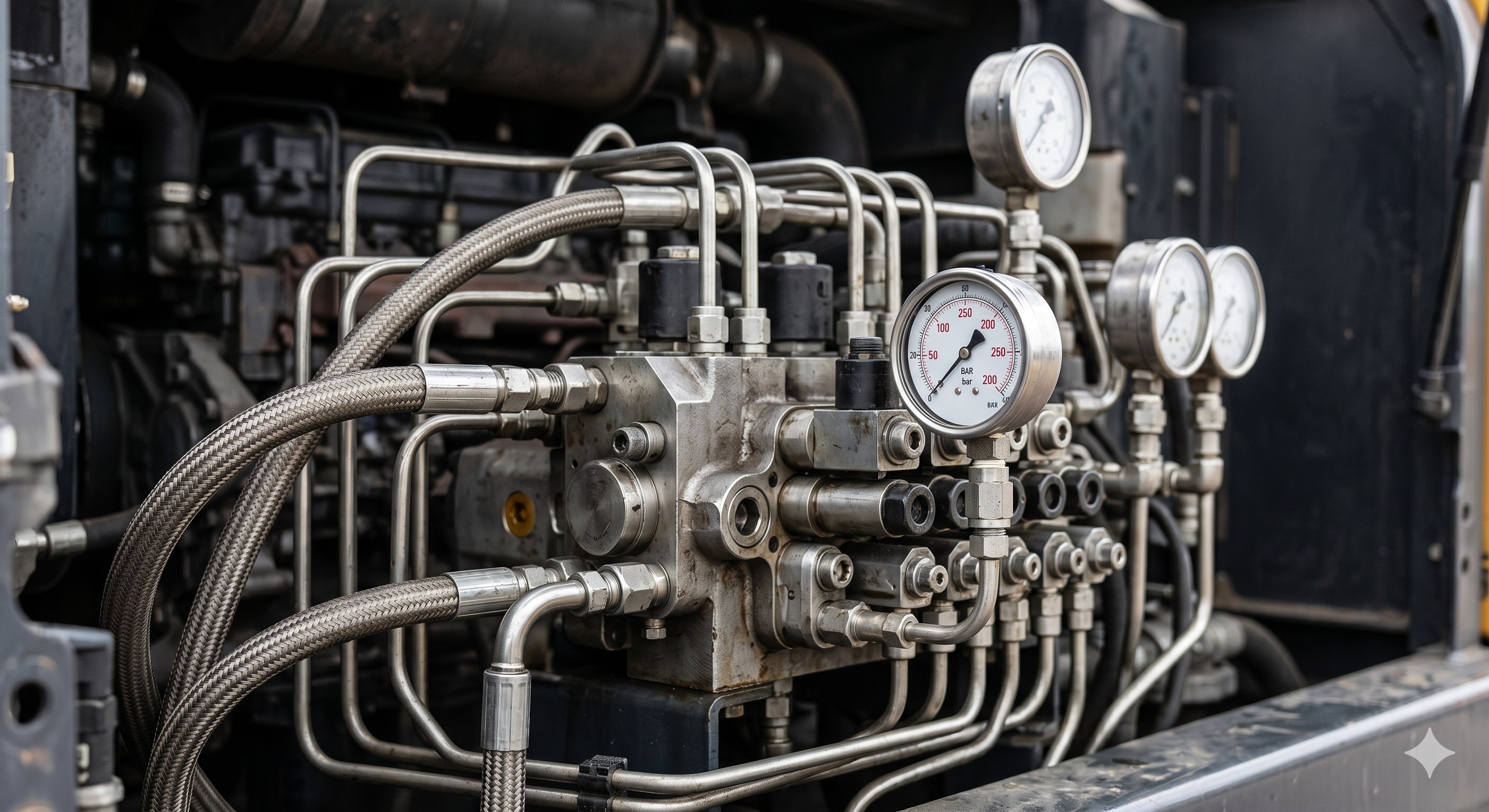
The heart of a stationary excavator is its load-sensing hydraulic network. Main pump flow ranges from 2×250 L/min to 2×380 L/min at 34-38 MPa (4,930-5,510 psi) operating pressure. Closed-center, variable-displacement piston pumps match flow to demand, reducing standby power loss by 40% compared to fixed-displacement designs. Independent boom, arm, and bucket circuits allow simultaneous movements without flow starvation. Hydraulic oil reservoir capacity (180-300 L) includes a 10-micron return filter and thermal bypass valve to maintain oil viscosity above 12 cSt. ISO 4406 cleanliness code 18/16/13 is mandatory for pump life beyond 10,000 hours.

Chassis & Undercarriage Durability

Without travel requirements, stationary excavators feature reinforced I-beam or box-section base frames welded from St52-3 or S355JR steel. Anchor points accept M36-M48 foundation bolts embedded in concrete pads (minimum compressive strength 35 MPa). Dynamic load factor is typically 2.0-2.5 for cyclic digging forces. The upper structure uses a cast-steel turntable bearing with induction-hardened raceways (rockwell hardness 58-62 HRC) and a greased dual-seal configuration. Bearing life at full radial load is calculated per ISO 16281 to exceed 25,000 hours. Standard ROPS/FOPS cabins comply with ISO 3449 Level II for falling object protection.

Technical Specifications

The following table provides representative parameters for a 45-metric-ton stationary excavator used in aggregate loading. Actual values vary by manufacturer and configuration.

Key Parameter Technical Specification (45-ton class)
Engine Horsepower (Net) 295 hp (220 kW) @ 1,900 rpm
Operating Weight 44,200 kg (97,444 lb)
Hydraulic Pressure (Main) 36 MPa (5,220 psi)
Main Pump Flow 2 × 320 L/min (total 640 L/min)
Standard Bucket Capacity (SAE) 2.5 m³ (heaped)
Max Digging Force (Bucket) 235 kN
Max Digging Force (Arm) 185 kN
Boom Length (Standard) 6.2 m
Arm Length 2.8 m
Swing Speed (Full circle) 9.5 rpm
Fuel Tank Capacity 520 L
Hydraulic Oil Tank 260 L
Emissions Standard EPA Tier 4 Final / EU Stage V
Operating Voltage 24V DC, 120A alternator
ROPS/FOPS Certification ISO 3449 Level II, ISO 3471

Comparative Advantage: TCO, Fuel Efficiency & ROI Analysis

Total Cost of Ownership (TCO) Over 10,000 Hours

For a dedicated hopper-feeding operation (1.2 million tons moved), TCO comparison between stationary excavator and tracked mobile excavator (same dig capacity):

  • Initial investment: Stationary - $420,000 (no undercarriage, simpler controls); Mobile - $520,000 (+24%).
  • Fuel consumption (10,000h): Stationary (avg 18 L/h) - 180,000 L; Mobile (avg 23 L/h + idle) - 230,000 L. At $1.10/L, stationary saves $55,000.
  • Maintenance & parts: Stationary eliminates track chain, idlers, sprockets, travel motors. Estimated stationary maintenance $0.12/ton vs mobile $0.19/ton → $84,000 savings.
  • ROI payback period: Lower initial capex + fuel + maintenance = average payback 14 months versus mobile baseline.

Efficiency Metrics

Cycle-based efficiency: stationary excavator achieves 380-450 cycles/hour (2.5m³ bucket, 90° swing, 4-second dump time) versus 300-350 cycles/hour for a tracked unit due to reduced stabilization time. Hydraulic efficiency measured per ISO 9249 is 88-91% at rated pressure. Annual CO2 reduction (based on fuel saving) equals approx. 38 metric tons.

Heavy-Duty Application Scenarios

Stationary excavators excel in four primary sectors:

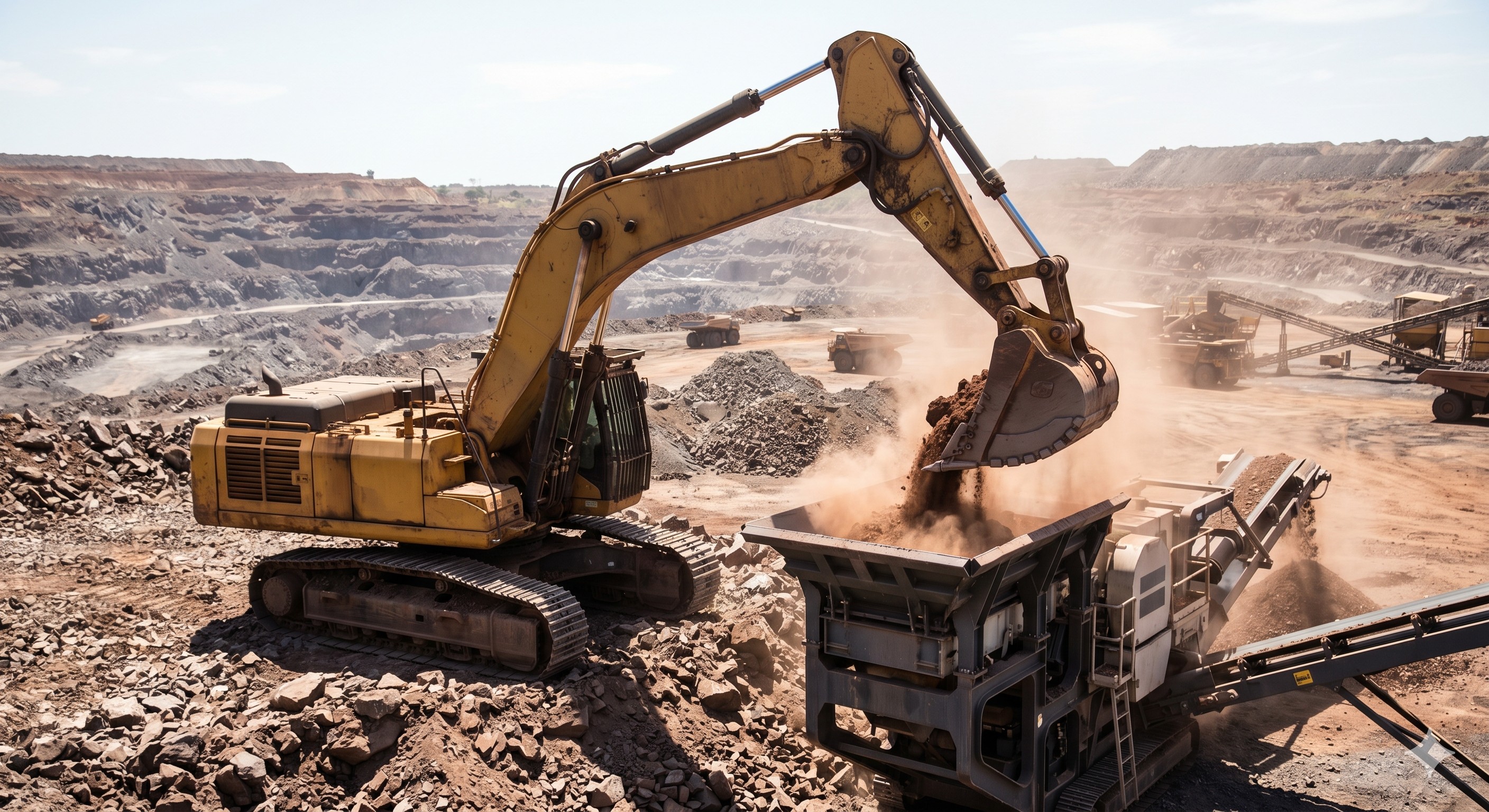
  • Mining & Aggregate Feed Hopper Loading: Positioned at crusher feed bins. Cycle times under 12 seconds. Handles run-of-mine material up to 800 mm³. Boosts crusher utilization to 92%.
  • Port & Barge Loading: Fixed boom configurations with 10-15 m reach. High-cycle barge trimming with remote control.
  • Industrial Pre-Homogenization Stockpiles: Linear or circular reclaimer duties. Continuous chevron stacking/layer removal.
  • Manufacturing Foundry Sand & Slag Handling: Heat-resistant boom options (up to 400°C material). High-dust sealing.

Conclusion: Engineering Productivity with Stationary Reliability

For operations requiring continuous, high-volume excavation at a single point, the stationary excavator outclasses mobile alternatives in TCO, hydraulic efficiency, and structural longevity. When specified with ISO-compliant bearings, Tier 4/Stage V engines, and load-sensing hydraulics, these machines deliver 20% higher cycle rates and 15% lower operating cost over 15,000 hours. Industrial engineering teams should evaluate their material flow, required reach, and duty cycle to select optimal boom length and pump flow. As automation and telemetry (CAN bus, vibration sensors, predictive oil analysis) become standard, the stationary excavator will further reduce unplanned downtime, solidifying its role in high-throughput bulk handling.

RFQ