Let's cut through the safety-speak. Aerial lifts are awesome. They let you reach places ladders can't, carry tools and materials, and get the job done fast. But they're also top-heavy machines with a person dangling in the air. Physics doesn't care how experienced you are.
Most accidents boil down to a handful of mistakes: setting up on uneven ground, overloading the platform, forgetting about overhead wires, or operating in wind that's stronger than you think. These aren't complicated errors. They're the kind of things you do when you're in a hurry or you've done it a hundred times without a problem.
The difference between a close call and a fatality is usually about six inches of ground that wasn't as solid as it looked, or one gust of wind you didn't account for.

You've seen them a million times. Scissor lifts that go straight up, boom lifts that reach out and over obstacles, little push-around lifts for warehouses. Officially they're called MEWPs (Mobile Elevated Work Platforms), but on site everyone just calls them lifts or man lifts .
The basic idea is simple: a platform that can raise workers to height, with controls in the basket so you can position yourself exactly where you need to be. They're stable when used right, but that stability depends entirely on the surface underneath and how you operate.
Not all lifts are created equal. If you're working on smooth concrete inside a warehouse, a standard electric scissor lift is probably your best bet. It's stable, easy to drive, and doesn't stink up the place.
But if you're out on a construction site with dirt, gravel, and slopes, you need something else. Rough terrain scissor lifts have four-wheel drive, chunky tires, and diesel engines. They're built to handle uneven ground without tipping .
For reaching out over obstacles—like hanging siding on a building or trimming trees—you need a boom lift. Telescopic booms go straight out, articulating booms can bend around things. Both are less stable than scissor lifts because they move in more directions, so ground conditions matter even more .
The takeaway: match the machine to the ground, not just the height you need.

Walk the site. Not a quick glance—actually walk it. Look for:
Holes, ruts, soft spots. That grass might look solid, but if it's been raining, it could be mud disguised as lawn.
Slopes. Even a gentle incline can turn a stable lift into a tipping hazard, especially with a boom extended .
Debris. Lumber, rebar, trash—anything that could puncture a tire or throw off your balance when you drive over it.
Overhead lines. Power lines will kill you dead if you touch them. Stay at least 10 feet away, more if the voltage is high .
Overhead obstructions. Beams, pipes, lighting—know what's above you before you go up.
Then inspect the machine. Don't assume the last guy did it. Check:
Controls for damage or sticking
Hydraulic hoses for leaks
Tires for proper inflation and tread
Platform guardrails for stability
Safety devices like tilt alarms and limit switches
If something's wrong, tag it out. Don't run it hoping it'll be fine.
Here's the rule that'll keep you alive: never raise the platform unless the machine is on firm, level ground . Sounds obvious, but it's the most violated rule on sites.
Level doesn't mean "looks about flat." It means within the manufacturer's slope limits. Most lifts have a tilt alarm that goes off if you're outside that range. If it beeps, don't override it. Move.
On rough terrain, even machines designed for it have limits. Check the slope rating in the manual. If you're near a drop-off—like an excavation edge or loading dock—stay back. The ground near edges can give way under the weight .
Once you're up, keep your head on a swivel.
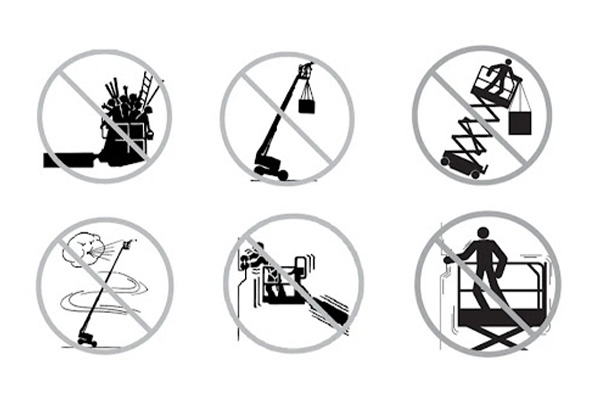
Don't exceed the load capacity. That includes you, your tools, and any materials. The rating is there because engineers did the math .
Keep the platform level. If you're on a slope, don't extend the boom to the downhill side—that shifts the center of gravity .
Watch for wind. High gusts can tip a boom lift or make a scissor lift sway dangerously. If it feels sketchy, come down .
Stay away from power lines. Assume every line is live. If you're working near them, have the utility company de-energize or cover them .
Don't climb on the guardrails. Ever. If you can't reach, move the lift. Leaning out is how people fall .
Inside might seem safer because there's no weather, but warehouses have their own dangers.
Forklift ramps often have a slight slope—enough to set off a tilt alarm if you're not careful .
Wet or greasy floors can make tires slip, especially on smooth concrete .
Overhead pipes, lights, and ducts can sneak up on you. Mark them if you have to work near them .
Pedestrians. Forklifts, pickers, people walking—they don't always watch for an overhead machine moving around. Use spotters if visibility is tight .
Scissor lifts are usually the indoor choice because they're compact and stable, but boom lifts get used too. Same rules apply: check the floor, check the ceiling, and keep people clear.
Wind is the big one. Every lift has a maximum wind speed rating, usually around 28 mph for boom lifts, less for some scissor lifts . But here's the thing—gusts can exceed sustained wind, and if you're up high, you feel it more.
Rain, snow, ice—they affect traction and visibility. If the platform feels slippery, or you can't see the ground clearly, it's time to come down.
Lightning? Don't even think about it. Get down and stay down until the storm passes.
This is where a lot of sites cut corners. "He's been running lifts for years, he doesn't need a card." Wrong. OSHA and most regulations require documented training for every operator, on every type of lift they use .
Training isn't just about passing a test. It's about knowing the specific machine's controls, limits, and safety features. A boom lift operates differently from a scissor lift. An electric lift handles differently from a diesel.
If you haven't been trained on that exact model, you haven't been trained enough.

Here's the short version of everything above:
Pick the right lift for the ground you're on.
Inspect the site and the machine before you go up.
Keep it level. If it tilts, move.
Stay within load limits—don't overload the basket.
Watch for overhead lines and obstructions.
Know the weather and don't push it.
Get trained. Get certified. Don't fake it.
Aerial lifts are tools, not toys. They make hard jobs easier, but they don't forgive carelessness. The ground doesn't care how late you are. The wind doesn't care that you've done this a hundred times.
Treat the machine with respect, follow the rules, and you'll get down the same way you went up—standing.
A: Yes. OSHA and most safety regulations require operators to be trained and certified for the specific type of lift they're using. Training covers controls, hazards, and safe practices. Don't skip it .
A: Setting up on uneven ground. Even a small slope can make a lift unstable, especially when the boom is extended or the platform is raised. Always check for level before going up .
A: Only if it's a rough terrain model rated for slopes, and only within the manufacturer's limits. Standard electric scissor lifts are for flat, hard surfaces only. If the tilt alarm sounds, don't override it—move .
A: Stay at least 10 feet away from lines up to 50kV. For higher voltages, you need more distance. If you're working near power lines, have the utility company de-energize or cover them. Assume every line is live .
A: There's not much you can do once it starts. Hold on, brace yourself, and hope the guardrails do their job. Prevention is everything—don't let it tip in the first place.
A: On most lifts, yes, but only on firm, level ground and at creep speed. Some manufacturers prohibit travel with the platform elevated except for positioning. Check the manual. And always watch for overhead obstructions .