WELCOME TO OUR BLOG

We're sharing knowledge in the areas which fascinate us the most
click

Buying a Roadheader: What Nobody Tells You Until You've Already Bought the Wrong One

By globalmachex March 13th, 2026 46 views

Quick Intro—Why a Roadheader Is Not a TBM


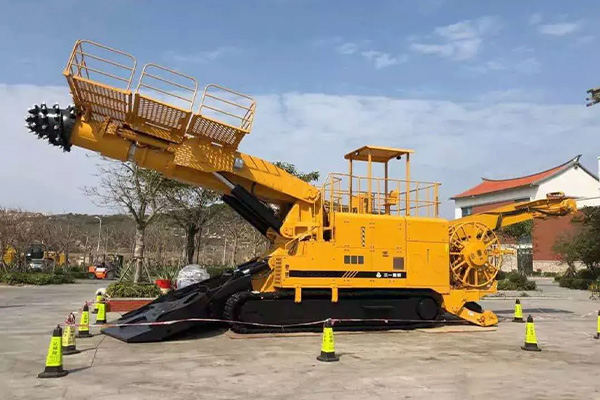
Let's get this straight from the start. A tunnel boring machine is a factory. It goes in a straight line, makes a perfect circle, and doesn't stop. A roadheader is a tool. It cuts, moves, turns, and adapts.

TBMs are for long, straight tunnels where you know exactly what you're getting into. Roadheaders are for everything else—cross passages, curves, irregular shapes, tight spaces where a TBM would never fit .

The advantage is flexibility. You can cut a horseshoe profile instead of a circle, saving concrete and money. You can make 90-degree turns. You can go around obstacles . A TBM can't do any of that.

But flexibility comes with trade-offs. Roadheaders are slower in hard rock. They wear out picks faster. They need more attention. The trick is knowing when the trade-off is worth it.

Answering the Main Question


What a Roadheader Actually Does Well

Roadheaders shine in certain situations:

Variable shapes. Need a tunnel that's not round? Roadheader's your machine . TBMs only make circles. Sometimes that circle is bigger than what you need, and you pay to fill the extra space with concrete. A roadheader cuts exactly what you want.

Curves and corners. Cross passages, ventilation adits, complex layouts—roadheaders turn where TBMs can't .

Precision. With electronic guidance, you can cut within 5 centimeters of your target . Drill-and-blast is lucky to hit 30 centimeters. That precision saves concrete, which saves money .

Urban work. In cities, you can't blast. Vibrations break windows, upset neighbors, and get permits revoked . Roadheaders cut quietly (well, quieter) and don't send shockwaves through buildings.

Where They Struggle

Here's the part nobody talks about at the demo.

Hard rock. Above 130-140 MPa compressive strength, the picks start dying . You can still cut, but your pick consumption goes through the roof. At some point, it's cheaper to blast.

Abrasive rock. Even if the rock isn't super hard, if it's abrasive, it eats picks . The Cerchar abrasivity index matters as much as strength.

Size limits. There's no real upper limit—you can cut big tunnels in sections—but there's a definite lower limit . The machine needs room. Figure about 45 centimeters clearance on the sides and 30 centimeters above .

If your tunnel is too small, the machine won't fit. If it's too big, you can still do it, but you're cutting in passes.

The Numbers That Actually Matter

Forget horsepower for a minute. Look at:

Compressive strength. What rock are you really cutting? Not the best-case sample. The worst-case. That's what matters.

Abrasivity. Cerchar index. High means more picks, more downtime, more cost.

Production rate. In good ground, roadheaders can advance 20 meters a day or more . In bad ground, much less. Be honest about what you'll average.

Pick life. This is your operating cost. If picks last 8 hours, you're changing them every shift. If they last 80, you're golden. Rock dictates this.

How to Actually Pick the Right Machine


Step One: Know Your Ground

Before you even call a supplier, know your rock. Not "it's hard." Numbers. Compressive strength tests. Abrasivity tests. Core samples from the actual tunnel alignment.

If you guess, you lose.

Step Two: Match the Machine to the Tunnel

Size matters. Width, height, curves. If your tunnel is tight, you need a compact machine. If it's big, you need reach .

Also consider access. How does the machine get to the face? Can it move under its own power? Do you need to disassemble and reassemble?

Step Three: Look at the Cutting System

Not all cutting heads are the same. Slow revolution heads give more torque for hard rock . Pick quality varies. Cheap picks wear fast. Good picks cost more but last longer.

Ask about wear parts. How hard are they to change? How long do they last in rock like yours?

Step Four: Consider the Conveyor

How does material leave the machine? Rear conveyors that swing side to side make truck loading easier . Bridge conveyors suspended from the roof keep material moving continuously .

If the mucking system is wrong, you'll spend half your time clearing the face instead of cutting.

Step Five: Electronics and Automation

Modern roadheaders have options:

  • Automatic cutting cycles that prevent motor overload
  • Connectivity to site networks for remote monitoring
  • Reporting software that tracks performance
  • Guidance systems that keep you on line

These aren't luxuries anymore. They're productivity tools .

Step Six: Support After the Sale

When a pick breaks at 2 a.m., can you get a new one? When the control system glitches, is there someone to call?

Supplier support matters more than you think. The cheapest machine is expensive if it's down half the time waiting for parts.

Summary


Here's the short version for when you're standing in the equipment yard trying to decide:

  • Roadheaders are for flexibility—curves, irregular shapes, precise profiles, urban work.
  • They struggle in hard rock (above 130-140 MPa) and abrasive ground.
  • Know your rock before you buy. Test it. Numbers, not guesses.
  • Match the machine size to your tunnel. Too big won't fit. Too small wastes time.
  • Cutting system and conveyor matter as much as the base machine.
  • Electronics help, but only if you know how to use them.
  • Supplier support keeps you running. Cheap machine with no support is no bargain.

Roadheaders are amazing tools when they're matched to the job. When they're not, they're expensive headaches. Do the homework first, buy second.

Frequently Asked Questions

Q: What's the hardest rock a roadheader can cut economically?

A: Generally around 130-140 MPa compressive strength. Above that, pick consumption gets too high. But if blasting isn't allowed, you might still choose a roadheader and accept the cost .

Q: Can a roadheader cut a tunnel bigger than itself?

A: Yes. You cut in sections—top heading first, then bench. Large tunnels might need multiple cuts .

Q: How accurate is roadheader excavation?

A: With electronic guidance, within 5 centimeters. Much better than drill-and-blast, which is more like 30 centimeters .

Q: What's the biggest advantage over drill-and-blast?

A: Continuous operation. Roadheader cuts, loads, and hauls in one continuous process. Drill-and-blast stops and starts—drill, load, blast, vent, muck .

Q: How do I know if my rock is too abrasive?

A: Cerchar abrasivity index testing. High numbers mean high pick wear. Factor that into your cost estimates .

Q: Do I need a guided system?

A: For precise profiles, yes. The savings in concrete alone often pay for the guidance system .

Mining Tools: The Real Deal on What Digs, Hauls, and Keeps You Alive Underground
Previous
Mining Tools: The Real Deal on What Digs, Hauls, and Keeps You Alive Underground
Read More
Crusher Safety: 8 Fatal Risks in Operation
Next
Crusher Safety: 8 Fatal Risks in Operation
Read More